Monday, June 30, 2014

Best Investment Firms Ranked by Advisors: J.D. Power 2014 Satisfaction Study

J.D. Power & Associates says that the overall level of satisfaction among both employee and independent advisors “remains relatively high,” according to its 2014 survey. However, large numbers of reps do not understand their compensation, and many also feel that the latest comp packages are unfavorable to them.

"Being paid competitively is important, but elements related to issues like clarity and consistency are also significant,” explained Michael Foy, director of J.D. Power & Associates’ wealth management practice in New York, in an interview. “A substantial number of advisors say they do not fully understand their compensation packages – 40%. Clearly that is a problem across both channels.”

The latest satisfaction study reflects the views of more than 3,900 advisors. It was redesigned from the prior year, with responses collected between January and April.

“There were a number of changes in compensation, particularly on the employee-advisor side,” Foy said. “About half of these advisors said their plans changed in the past year, with four out of 10 saying the changes were negative.”

In the independent channel, only about a third of reps experienced compensation changes, with about one in four having negative views of the new comp plans.

Despite these compensation issues, overall satisfaction among employee advisors increased to 721 (on a 1,000-point scale) from 695 a year ago, and satisfaction among independent advisors fell to 778 from 794.  

Also, 87% of employee reps and 93% of independent advisors say they “definitely will” or “probably will” remain at their current firm for the next one or two years, the survey finds.

Still, cautions Foy, the survey results should not make investment firms complacent. 

When financial markets are doing well, investment firms might have “a false sense of security for their future success,” he says. “As markets turn around, it’s likely that we will see some erosion in satisfaction.”

As a result, firms should do a better job of communicating with their advisors about the firm’s strategic vision, culture and compensation. “It’s crucial for such communication to occur, so that advisors buy into strategy, understand the vision and compensation, and are able to use tools of support like technology and marketing across the board.”

Keep reading to see how advisors assessed each of the major investment firms in the employee and independent channel:

Best Investment Firms for Advisor Satisfaction: Employee Advisors

Source: J.D. Power & Associates, June 30, 2014. *Prior-year data not available.

Best Investment Firms for Advisor Satisfaction: Independent Advisors

Source: J.D. Power & Associates, June 30, 2014. *Prior-year data not available.

---

Related on ThinkAdvisor:

Saturday, June 28, 2014

Boost from iPhone 6 Will Push Apple Stock to Record High

The iPhone 6, the next major upgrade to Apple Inc.'s (Nasdaq: AAPL) flagship product, isn't due out until September.

But we've gleaned enough leaked information to project that it will bring in enough revenue and profit to get Apple stock back to its all-time high - $100.72 - and beyond.

So what do we know about the iPhone 6?

#symbols-c4ca4238a0b923820dcc509a6f75849b { width: 253px; font-family: Arial; font-size: 11px; color: #333333; } #symbols-c4ca4238a0b923820dcc509a6f75849b .header { float: left; font-family: Georgia; font-size: 14px; color: #456626; line-height: 14px; padding-left: 14px; font-weight: bold; } #symbols-c4ca4238a0b923820dcc509a6f75849b .date { float: right; padding-right: 32px; font-weight: bold; } #symbols-c4ca4238a0b923820dcc509a6f75849b .chart { font-family: Georgia; font-size: 12px; color: #456626; width: 253px; height: 135px; line-height: 135px; text-align: center; } #symbols-c4ca4238a0b923820dcc509a6f75849b ul { list-style: none; padding: 0; margin: 0; } #symbols-c4ca4238a0b923820dcc509a6f75849b li { padding: 0; margin: 0; } #symbols-c4ca4238a0b923820dcc509a6f75849b li:nth-child(odd) { background-color: #eeebe6; } #symbols-c4ca4238a0b923820dcc509a6f75849b .symbols-item .name { float: left; width: 100px; overflow: hidden; padding: 3px; } #symbols-c4ca4238a0b923820dcc509a6f75849b .symbols-item .price { float: left; width: 55px; overflow: hidden; padding: 3px; text-align: right; } #symbols-c4ca4238a0b923820dcc509a6f75849b .symbols-item .percent { float: left; width: 80px; overflow: hidden; padding: 3px; text-align: right; } #symbols-c4ca4238a0b923820dcc509a6f75849b .symbols-item.active { background-color: #456626; color: #ffffff; } #symbols-c4ca4238a0b923820dcc509a6f75849b .chart-container { width: 253px; height: 135px; padding: 0 0 5px 0; } #symbols-c4ca4238a0b923820dcc509a6f75849b .chart-container img { width: 253px; height: 135px; max-width: none; } .clear { clear: both; } Apple NASDAQ: AAPL Jun 27 loading chart... Price: 91.98 | Ch: 1.08 (1.2%)

Other than its likely release date, the consensus is that the iPhone 6 will come in not one but two larger display sizes - 4.7 inches and 5.5 inches - than the current top-of-the-line iPhone 5S, which has a 4-inch display.

Apple misjudged the popularity of larger-screen smartphones, but the strong sales of such phones based on Google Inc.'s (Nasdaq: GOOG, GOOGL) Android operating system hints at significant pent-up demand for a larger iPhone - and not just in the United States.

Apple stock"This is a smart move for them," said Money Morning Defense & Tech Specialist Michael Robinson. "The emerging markets, particularly China, they like a larger screen. Forty percent of the smartphones sold in China recently were five inches or larger. So this larger iPhone really helps segment them, and it comes after the China Mobile (NYSE ADR: CHL) deal. I think this is going to be very successful."

We also know that the iPhone 6 will run Apple's latest mobile operating system, iOS 8, which was discussed in detail at the company's Worldwide Developers Conference (WWDC) earlier this month.

You can be sure that the iPhone 6 will be designed to exploit such iOS 8 features as the HealthKit app, which helps users track health and fitness, and iBeacon, which sends shopping information to a user's phone based on where they're standing inside a store.

And of course there should be the usual upgrades to the cameras, battery life, central processor, etc., that will make the iPhone 6 a very compelling buy for both customers new to the platform as well as those wishing to upgrade.

And there are plenty of current iPhone owners ripe for an upgrade. According to Morgan Stanley (NYSE: MS), about half of all iPhone owners in the United States are still using an iPhone 4 or iPhone 4S.

A survey in April by research firm ChangeWave showed that 40% of early adopters were at least "somewhat likely" to buy an iPhone 6 - "the highest level of demand for an unannounced Apple model in a ChangeWave survey," Andy Golub of 451 Research told Fortune.

Now let's take a look at how the sales success of the iPhone 6 that will affect AAPL stock...

How the iPhone 6 Will Turbocharge Apple Stock

In the weeks since Apple outlined the new features of iOS 8, and more details about the iPhone 6 have been leaked, analysts have been falling over themselves in a mad scramble to jack up their price targets on AAPL stock.

Since the 7-to-1 Apple stock split took effect June 9, the shares have traded in the low $90s, near or below the target prices of many analysts. A summary of the action over the past few weeks:

Goldman Sachs: $102.86 (made just prior to WWDC) Needham: $97 RBC Capital Markets: $100 Cowen & Company: $102 JPMorgan Chase: $108

Virtually every analyst cited an expectation for huge iPhone 6 sales as a major reason for their AAPL price target increases, most of which exceed the all-time high.

Cowen analyst Timothy Arcuri said in a research note that Apple could sell as many as 100 million iPhone 6 models in the December quarter. Apple sold 44 million iPhones in its most recent quarter.

Charlie Wolf of Needham sees the iPhone 6 adding $10.29 to the Apple stock price over the next year. Mind you, prior to the split that would have been a hefty $72.

Robinson agrees that the iPhone 6 will deliver significant upside to AAPL stock.

"I think the iPhone 6 could add 8% to 12% to the Apple stock price," he said.

Robinson also noted that while the iPhone dominates Apple's earnings, the company's dividend and share buyback program, as well as rising sales of other products, including new products such as the iWatch, will also help propel AAPL higher.

Even a conservative scenario has Apple stock at least edging very close to its all-time high.

"Apple stock is up 20% since the most recent earnings announcement. So, even if the iPhone 6 release gives us only half as much of a catalyst, we're still talking gains of around 10%," Robinson said.

Are you excited about the prospects for the iPhone 6? Do you agree that it will provide the fuel to drive the Apple stock price to a new all-time high? Tell us on Twitter @moneymorning or Facebook.

UP NEXT: When Michael Robinson looks at Apple stock, he sees much more than a maker of the iPhone and other tech gadgets. When he watched the events unfold at WWDC, he saw something much bigger. Michael says these initiatives will drive AAPL up by 50% or more...

Related Articles:

Fortune: Survey: 40% of Early Adopters Would Buy a Bigger iPhone AppleInsider: Needham Raises Apple Target to $97, Expects Swift Programming Language to Enhance iPhone Superiority

Friday, June 27, 2014

Consumer Spending Ticks Up; Jobless Claims Tick Down

Consumer Spending Sarah Bentham/AP WASHINGTON -- U.S. consumer spending rose less than expected in May, likely held back by weak health care spending, which could prompt economists to temper their second-quarter growth estimates. The Commerce Department said Thursday consumer spending increased 0.2 percent after being flat in April. Spending, which accounts for more than two-thirds of U.S. economic activity, had been forecast rising 0.4 percent. When adjusted for inflation, consumer spending fell for a second straight month, suggesting spending this quarter could struggle to regain momentum after growing at its slowest pace in nearly five years in the first quarter. Spending in May was probably constrained by weak health care spending as outlays on services barely rose for a second month. Spending on automobiles surged, accounting for more than half of the rise in durable goods outlays. U.S. Treasury debt prices rose on the data while the dollar trimmed gains. Reports on employment to manufacturing and the services industries suggest the economy has rebounded after sinking in the January-March period, but the spending data indicated that growth would probably fall short of expectations. "The consumer spending number is not enough of an acceleration to give confidence to large second-quarter GDP rebound numbers," said Alan Ruskin, global head of G10 foreign exchange strategy at Deutsche Bank (DB) in New York. Second-quarter growth estimates have ranged as high as a 4 percent annual pace. The economy contracted at a 2.9 percent pace in the first quarter, the worst performance in five years. In a separate report, the Labor Department said new applications for state unemployment benefits slipped 2,000 to a seasonally adjusted 312,000 for the week ended June 21. The declining claims suggest a recent streak of payroll job gains above 200,000, is likely to be sustained, lending the economy enough momentum for inflation to start perking up. Inflation Ticking Up A price index for consumer spending increased 0.2 percent in May, rising by the same margin for a third consecutive month. In the 12 months through May, the personal consumption expenditures price index was up 1.8 percent, the largest gain since October 2012. It had advanced 1.6 percent April and should comfort Federal Reserve officials concerned about price pressures being too low. Excluding food and energy, prices also posted a 0.2 percent gain. That followed a similar increase in April. The so-called core PCE price index increased 1.5 percent from a year ago. That was the biggest increase since February last year and followed a 1.4 percent rise in April. Both inflation measures still remain below the Fed's 2 percent inflation target. Inflation, which has been depressed by weak medical care costs and sluggish wage growth, is being watched for clues on the timing of the central bank's first interest rate hike. The Fed, which is scaling back the amount of money it is pumping into the economy through monthly bond purchases, has kept its benchmark lending rate near zero since December 2008.

Wednesday, June 25, 2014

Google: Innovative Powerhouse

We've been watching a company whose innovative approach has taken it far beyond its origins as a search engine; it is exploring a wide range of technological frontiers from driverless cars to robots to high-tech glasses, explains Gordon Pape, editor of Internet Wealth Builder.

Google (GOOG) is a powerhouse. It would not surprise me to see it overtake Apple (AAPL) as the world's largest corporation within a couple of years.

Last year, it took in stand-alone revenue of $15.7 billion (not including Motorola Mobile. That was an increase of 22% over 2012.

The company reported net income of almost $3.4 billion ($9.90 per share, fully diluted), up 17% from $2.9 billion ($8.62 a share) in fiscal 2012.

The company ended the year with cash and marketable securities worth a mind-boggling $58.7 billion, compared to $48.1 billion at the end of 2012. By comparison, long-term debt is only $2.2 billion. Google is rolling in cash!

The company is using some of that cash to make strategic acquisitions. The most recent was the eyebrow-raising $3.2 billion purchase of Nest, announced in mid-January.

Nest is in the business of manufacturing thermostats and smoke detectors, which seems far removed from anything Google does. But the purchase offers an opening for the company to gain a foothold in the smart home sector.

It also brings iPod designer Tony Fadell (Nest's CEO) into the Google fold, which, as Wired magazine pointed out in a recent article, gives the company "near-instant—and much-needed—credibility in the world of hardware."

Some of its projects will inevitably be written off. But the successful ones will translate into hundreds of millions of dollars in new revenue, as happened with the Android operating system.

I know it's going out on a long limb but it's feasible that Google could be the Berkshire Hathaway (BRK-B) of the 21st century—a widely diversified and hugely successful company that everyone wants to emulate.

Whatever happens, I want to be a part of it, hence my small share purchase. I'm adding Google to my Recommended List as a primary core US holding.

Subscribe to Internet Wealth Builder here…

More from MoneyShow.com:

Boeckl's Bets: The Long-Cycle for Tech

Contrarian Fuel Lights Up Marvell

The "Smart" in Smartphone

Tuesday, June 24, 2014

The Rise of Bitcoin Will Crush These Stocks

Let's call them the Bitcoin stock losers - payment processing companies that stand to have their business models severely disrupted, if not wiped out, by the widespread adoption of Bitcoin.

While still in its infancy, Bitcoin has several key advantages over other forms of payment processing.

Bitcoin stockAs today's Bitcoin startups make the digital currency easier to use, those advantages will become more apparent to the general public, setting off a mass transition away from traditional forms of payment such as credit cards.

While this may be hard to imagine right now, the Bitcoin ecosystem is already established and growing. In three to five years, it will reach a tipping point where Bitcoin will be accepted in most places and most people will have seamless ways to use it, primarily on their smartphones.

That's when Bitcoin's threat to the $48 billion in annual credit card fees and $37 billion in international money transmission fees will hit home.

You'd think the Bitcoin stock losers - the credit card companies, big banks, and international payment companies - would be worried.

Not at all.

In fact, the companies most threatened by Bitcoin, the credit card industry, haven't even bothered to list the digital currency as a risk in U.S. Securities and Exchange Commission (SEC) filings.

"I'm a bit skeptical," David Nelms, the chief executive officer of Discover Financial Services (NYSE: DFS), told Bloomberg News. "[Other things pose] a lot more potential threats or opportunities than Bitcoin."

Nelms is not alone. The heads of American Express Co. (NYSE: AXP), Visa Inc. (NYSE: V) and MasterCard Inc. (NYSE: MA) have all been dismissive regarding any adverse impact the growth of Bitcoin might have on their businesses.

For that matter, so have the executives of several big banks as well as the international payment companies.

"Today, people speculate on the potential," Alex Hoffmann, executive vice president of global product management and emerging channels at MoneyGram International Inc. (NYSE: MGI), told Bloomberg News. "But today you do not have it."

Here's why these executives are dead wrong - and how their inability to see what's coming is going to pummel their stocks.

How the Bitcoin Stock Losers Will Be Ruined

Among the executives of payment processing companies disregarding the Bitcoin threat, a common ploy is to point to a perceived weakness as a reason the digital currency doesn't threaten their business.

What they don't seem to realize is that each of these issues can be fixed, and is in the process of being fixed, by a blossoming collection of Bitcoin startups.

Visa CEO Charlie Scharf said Bitcoin is "complex," implying it's hard for ordinary people to use.

This is somewhat true now, but is changing quickly. There are already several Bitcoin wallet apps for smartphones available. It's also no coincidence that the Bitcoin startup that has raised the most venture capital so far ($32.7 million) is BitPay - a payment processor company.

Within the next year or two, paying with Bitcoin will be at least as easy as using a credit card.

Some point to Bitcoin price volatility as a problem, but Bitcoin payment processors serving merchants already have mitigated that by converting the transactions to dollars immediately at the time of the sale.

Other executives scoffed at Bitcoin's relatively small footprint. Daily transaction volume in Bitcoin is only about $50 million, dwarfed by the $3.7 trillion processed by giants MasterCard and Visa.

But one year ago Bitcoin transaction volume was only about $7 million a day. That's a seven-fold increase - in just one year. In a few years, as the ecosystem grows, the daily transaction volume will be in the billions.

And several executives laughably claimed their systems were more secure and trustworthy than anything based on Bitcoin, which isn't even true now. Have they already forgotten the massive credit card data breach at Target Corp. (NYSE: TGT) last year?

While bitcoins have been lost and stolen from exchanges like Mt. Gox, the cause was not a flaw in the Bitcoin protocol but weak systems and bad habits (like not keeping most of the bitcoins offline in "cold storage").

As a payment mechanism, Bitcoin is far superior to credit cards.

Each transaction only contains an address (a unique string of characters) for the sender, an address for the recipient, and the amount of Bitcoin being transferred between them.

The address can only successfully send Bitcoin if it has access to the private key associated with a person's Bitcoin wallet. This private key is never sent as part of the transaction, however.

But just as importantly, using Bitcoin instead of a credit card also means that no personal data is transmitted or stored. That leaves potential data thieves empty-handed save for the Bitcoin addresses, which are useless without the private keys.

Yet there's one more reason that will drive people to use Bitcoin over other payment systems more than any other...

Merchants and Customers Save on Fees with Bitcoin

Costs drive behavior in the business world, and Bitcoin's greatest advantage over legacy payment processors is that it is far cheaper.

The fees that credit card companies charge, in concert with the banks that issue the cards, vary, but typically range between 2% and 3% of each transaction. Compare that to the 1% fee that Coinbase charges merchants to process payments made in Bitcoin.

That's one reason why merchants like Overstock.com Inc. (Nasdaq: OSTK) started accepting Bitcoin.

Imagine what will happen to the Bitcoin stock losers when the digital currency goes mainstream over the next few years - a decade at most. Those billions in annual fees will start to decline. It will start slowly, but will suddenly accelerate as Bitcoin usage becomes commonplace.

That's when the stocks of the credit card companies will crater, like BlackBerry Ltd. (Nasdaq: BBRY) did in 2011 after smartphones swallowed up its market share.

The banks that issue the cards will also take a hit, though not as badly. That would include such big names as JPMorgan Chase & Co. (NYSE: JPM), Bank of America Corp. (NYSE: BAC), and Citigroup Inc. (NYSE: C).

And because Bitcoin can easily be converted to various world currencies in addition to moving money cheaply, it is also likely to steal business from international payment companies like MoneyGram and Western Union Co. (NYSE: WU).

It will take time, for sure, but the longer the Bitcoin stock losers dismiss the threat, the more difficult it will be for them to cope with it when it becomes too big to ignore.

Tomorrow: The Bitcoin stock winners.

Up Next: One of the surest signs that the Bitcoin economy is gaining traction is the speed at which venture capital is pouring into Bitcoin startups. Here's what venture capitalists are seeing that has them so excited...

Related Articles:

Bloomberg News: Bitcoin Seen as Little Threat to Payment Firms Bloomberg News: Could Bitcoin Be Trouble for Visa and MasterCard?

Monday, June 23, 2014

Uncovering Value in MLPs

Energy sector specialist Elliott Gue, editor of Energy & Income Advisor, helps unravel the complexity of master limited partnerships—highlighting two favorites for growth and income potential.

Steve Halpern: We're here today with Elliot Gue, editor of Capitalist Times and the Energy & Income Advisor. How are you doing today, Elliot?

Elliot Gue: Good, good. How are you? Thanks for having me on the program.

Steve Halpern: My pleasure. Today we're going to be discussing master limited partnerships, specifically, recent IPOs in the sector. First, let's look at the structure of these investments for our listeners who might not be familiar, and you note that MLPs are usually comprised of two entities. Could you explain that?

Elliot Gue: Sure, well MLP, or a master limited partnership, is typically comprised of a limited partner, or LP, and a general partner, or GP.

Now, when you buy an MLP you're typically buying a stake in the limited partnership and what that means is that you're entitled to receive regular distributions, which represent a share of the cash flows generated by that business.

But with the limited partner, you, typically, have no interest in the actual management of the MLP so, in other words, you're not making decisions or voting on decisions like, "shall we make this acquisition?" or to go ahead with a new pipeline construction project, or to go ahead with new oil storage terminal.

That management path is undertaken by the GP, or the general partner. Now what's really important about this relationship is that the LP—which is, basically, you and me who buy the MLP—we pay a fee to the general partner in exchange for managing and helping to grow those assets over time.

That fee is called an Intensive Distribution Right (or IDR) and, typically, those IDRs rise—the share of IDR rises as the underlying distributions of the LP to the MLP increases. The reason it works that way is it's basically incentivizing the general partner to make decisions that allow the underlying LP to grow its payout to new holders or shareholders.

It's typically a very good relationship, particularly in the earlier years of a partnership's existence because it's designed to encourage growth and yield, and MLPs—most people buy master limited partnerships for that yield.

The average MLP in the US yields a little over 6%, which, of course, is many times what the S&P yields right now, so it's typically a very good relationship but you have to watch it very carefully because at some point in the future, you can get into a situation where the general partner is taking too large a fee as an IDR out of that LP which affects their ability to grow distributions going forward.

Steve Halpern: As you pointed out, in order to attract investor attention, these MLPs offer particularly high yields in the first few years. What specific factors do you look at to determine if these distributions will be maintained and continue?

Elliot Gue: Right. Well, most master limited partnerships, or MLPs, are involved in what we call the midstream energy business. Basically, the energy business is divided up into three parts; you have upstream, which is actual oil and gas production. There are handfuls of about a dozen MLPs in that segment.

Then you have the midstream, which is really transportation and storage, so it's owning things like pipeline, like natural gas storage caverns like oil terminals and tankers. That would be midstream, transportation, and storage.

Then you have downstream, which is usually refining. There's just a couple of MLPs involved there. About 80% are involved in that midstream area, 80%, 90%. Now that area is typically very stable business.

Page 1 | Page 2 | Page 3 | Next Page The expert featured in this column, Elliott Gue, may or may not own positions in any investment vehicle mentioned here. The views and opinions expressed are his or her own.

4 Investing Ideas From BP's 2014 World Energy Review

BP's (NYSE: BP  ) Statistical Review of World Energy shows the limited options that face the global energy system. With 2013's primary energy growth rate of 2.3% falling below its 10-year average, there are signs that the search for economical, emission-light energy is taking its toll. A diversified portfolio is the only way to help adjust the energy system we have inherited. 

Natural gas 
Turnaround plays are not only exciting, they can be very profitable. Chesapeake Energy (NYSE: CHK  ) has been accumulating cash, and recently announced that non-core asset sales are expected to help decrease its net leverage by $3 billion with a limited impact on 2014 production. Basically, the company continues to rationalize its capex budget. From 2010 to 2013 Chesapeake's net cash used in investing activities has fallen from $8.5 billion to $3 billion.

BP's Statistical Energy Review notes that in 2013 only the U.S. saw above-average growth of natural gas consumption. Thanks to a growing distribution network, Chesapeake is right in the middle of the shale boom. It continues to develop unconventional plays like the Utica and Marcellus to reach its goal of producing 1 million barrels of oil equivalent, or BOE, per day. Natural gas is a relatively clean fuel, and the EPA's push to make America's utilities less carbon-intensive puts more wind in Chesapeake's sails.

Coal 
Our old friend coal is not painted in a very flattering light, but in 2013 it was the fastest growing fuel and reached its highest portion of primary energy production since 1970.

China's leader Xi Jinping stated that the nation needs an energy revolution to deal with pollution issues and supply challenges. This is not encouraging news for coal, as China contributed 67% of coal's demand growth in 2013. The upside is that other big Asian consumers like India are there to help pick up the slack. 

Not all coal is the same. Utilities can buy relatively clean, low-sulfur Powder River Basin coal from Cloud Peak Energy (NYSE: CLD  ) , or stick to more traditional dirty sources.  China and the U.S. are tiring of highly polluting coal, and Cloud Peak Energy is a critical part of the solution.

Cloud Peak Energy already has access to critical export facilities on the Pacific Coast. The company's 1.5% profit margin is slim, but its 18.1% gross margin and 6.3% EBIT margin give it room to breathe, while marginal coal producers are forced to reduce production.

Nuclear 
Global nuclear energy output grew by 0.9% in 2013. This is significant as it was the first increase since Fukushima rocked the world in 2011. Nuclear now accounts for its smallest percentage of global energy production since 1984.

In the midst of these difficulties, nuclear still has a strong future thanks to its military applications and baseload capabilities. Nuclear weapons are an important part of the nation's military, and escalating tensions continue to bring Asian nuclear abilities to the forefront. In addition to the security applications, nuclear energy provides a straightforward way to replicate coal's baseload generation without emissions.

Cameco (NYSE: CCJ  ) is the world's preeminent pure-play uranium miner. It has a host of high-quality mines and a small total debt-to-equity ratio of 0.25. Its margins are low as the industry is still recovering from Fukushima, but this has allowed Cameco to buy up assets from potentially dangerous competitors. The good news is that its gross margin of 35.2% lets it sit back and watch the market recover.

Renewables
In 2013 Renewable Energy used in power generation grew 16.3%, contributing a total of 5.3% of global power generation. SunPower (NASDAQ: SPWR  ) is on the right side of this growing industry. Its high-efficiency solar panels and low degradation rate let its solar panels produce 75% more energy than its competitors on a given rooftop over 25 years.

SunPower's distributed generation operations still face risks from unstable government policies, but its push to commercialize energy storage solutions in Australia will eventually help to decrease its dependency on retail feed-in-tariffs. Its profit margin of 5.4% shows that renewables are already in the black.

Final thoughts
The 20th century was dominated by fossil fuels. Fossil fuels continue to play a significant role, but a move to emission-light generation is pushing SunPower, Chesapeake, Cloud Peak Energy, and Cameco to the forefront of the energy industry.

Do you know this energy tax "loophole"?
You already know record oil and natural gas production is changing the lives of millions of Americans. But what you probably haven't heard is that the IRS is encouraging investors to support our growing energy renaissance, offering you a tax loophole to invest in some of America's greatest energy companies. Take advantage of this profitable opportunity by grabbing your brand-new special report, "The IRS Is Daring You to Make This Investment Now!," and you'll learn about the simple strategy to take advantage of a little-known IRS rule. Don't miss out on advice that could help you cut taxes for decades to come. Click here to learn more.

Saturday, June 21, 2014

Cardiovascular Systems: Heart-Felt Buy

Among our latest small-cap recommendations is a medical device company focused on developing minimally invasive treatment solutions for vascular disease, including peripheral artery disease (PAD) and coronary artery disease (CAD), explains Jim Oberweis, Editor of The Oberweis Report.

Cardiovascular Systems, Inc. (CSII) sells devices (called atherectomy devices) that remove the plaque altogether versus traditional angioplasty devices that push the plaque into the vessel.

The company's original system for the PAD market was launched in 2007 following FDA clearance, with their latest third generation version being launched in 2011.

CSII's device is superior, versus other atherectomy devices, because it can differentiate between hard plaque and soft vessel tissue and can treat multiple vessels in one procedure.

The company most recently received approval from the FDA in October 2013 for their CAD system as a treatment for severely calcified coronary arteries. This represents the first atherectomy product to treat moderate to severe plaque in coronary arteries in over 20 years.

CSII plans to leverage their existing sales force, which already targets interventional cardiologists, once the limited launch is complete; we expect sales to ramp more significantly in the second half of 2014.

Because this is an early stage medical device company planning to invest in sales and marketing, and further research and development, ahead of a substantial market opportunity, we do not expect bottom line profitability in the coming quarters.

However, given an estimated $2 billion PAD market opportunity, in which the company expects to gain market share, coupled with an upcoming launch into the $1.5 billion CAD market, we feel the stock represents an attractive opportunity at present.

In the company's latest reported second quarter, sales increased approximately 28% to $32.3 million from $25.3 million in the second quarter of last year. Clients of Oberweis Asset Management own approximately 288,000 shares. These shares may be appropriate for risk-oriented investors.

Subscribe to The Oberweis Report here…

More from MoneyShow.com:

PAREXEL: A Cornerstone Buy

Salix: Gastro Powerhouse

Favorite Pharmas for Value Investors

House Committee Votes to Block SIFI Designations

The House Financial Services Committee today reported to the House floor along party lines two bills that would effectively shut down the operations of the Federal Stability Oversight Council (FSOC) for at least the next year.

The bills were passed by a 32-27 party line vote today.

However, analysts give long odds that these bills will become law.

It responds to concerns by MetLife specifically, and the money management and mutual fund industries in general, that designation of firms in their sectors as systemically important would be harmful and could make these companies uncompetitive.

They were pushed through the committee by conservative members who believe in less regulation, led by Rep. Jeb Hensarling, R-Texas, chairman of the committee, and Rep. Scott Garrett, R-N.J., who heads the panel’s Capital Markets Subcommittee.

One bill, H.R. 4881, would bar the FSOC from designating any systemically significant financial institutions for a year.

The chief sponsor of that bill, Rep. Randy Neugebauer, R-Texas, chairman of the Housing and Insurance Subcommittee, said in support of it Thursday that “I strongly believe that FSOC’s structure and its process for designating systemically important firms are fatally flawed.”

He said that, “Rather than using data, history, and economic analysis to justify SIFI designations, FSOC has used far-fetched, highly speculative ‘worst-case scenarios’ to justify an aggressive expansion of regulatory power from Washington.”

And, Neugebauer added, recent evidence shows that rather than making its own determinations about the systemic significance of large U.S. non-bank financial institutions, the FSOC has instead rubber-stamped decisions made by the G-20’s Financial Stability Board.”

Rep. Maxine Waters, D-Calif., ranking minority member of the committee, railed against it during Thursday’s debate.

“Under the guise of concerns about transparency, Republicans want the FSOC to halt its work, even if it has identified a firm that poses a risk to the economy, a threat to my constituents who want to buy a house, a car, or simply purchase groceries at the store.  /* .premium-promo { border: 1px solid #ddd; padding: 10px; margin: 0 10px 10px 0; width: 200px; float: left; } .premium-promo li, .premium-promo ul { list-style-type: none; margin: 0; padding: 0; } .premium-promo li { margin: 0 0 10px; padding: 0 0 10px; border-bottom: 1px dotted #ddd; } .premium-promo h3 { text-transform: uppercase; font-size: 11px; } .premium-promo h4 { font-size: 16px; } .premium-promo a { text-decoration: none !important; } .premium-promo .btn { background: #0069a1; border-radius: 4px; display: inline-block; padding: 5px 10px; clear: both; color: #fff; font-weight: bold; } .premium-promo .btn:hover { background: #034c92; } */ “No, this is not a good-faith effort to increase transparency, because ultimately my colleagues on the other side of the aisle want to end the FSOC altogether,” Waters added. 

The other bill, H.R. 4387, would allow all members of the commissions and boards represented on the FSOC — such as the Securities and Exchange Commission, the Federal Reserve, the Commodity Futures Trading Commission, and the National Credit Union Administration — to attend and participate in the FSOC’s meetings.

The bill also requires that before the principal of a Commission or Board represented on the FSOC votes as an FSOC member on an issue before the FSOC, the Commission or Board must vote on the issue, and the principal must follow that vote at the FSOC meeting.

The bill permits Members of the Committee on Financial Services and the Committee on Banking, Housing and Urban Affairs to attend all FSOC meetings, whether or not the meeting is open to the public.

In introducing the bill, Garrett said that, “The council meets in secret, refuses to disclose substantive transcripts, and blocks any requests by other regulators or Members of Congress for a more open and transparent process.” In April, Garrett was denied access to an FSOC meeting.

He noted the “tremendous changes” that the FSOC is considering in the way capital and credit are allocated and said “it is imperative these changes are not carried out in secret or behind closed doors.”

In debate on the bills Thursday, Waters said that Garrett’s bill politicizes membership by adding regulators’ commissioners and board members into the mix and that giving the committee members access to closed-door meetings on systemic risk might be unconstitutional. 

“We are not dealing with a good-faith effort to address many of the transparency concerns a bipartisan group of members have raised,” Waters said. “Rather, this is an effort by Republicans to make the FSOC decision-making impossibly difficult.”  

The bill’s immediate impact would likely be on the designation of MetLife as a systemically significant financial institution or SIFI. MetLife is in Stage III or the final stage, of the SIFI designation process. MetLife has been lobbying against designation as a SIFI for more than a year, and the FSOC has responded by slowing its decision-making process on MetLife to ensure it has all its ducks in a row before making a decision.

But, it would also impact money market mutual funds and money managers, who have been notified they are under scrutiny for possible designation as SIFIs.

The FSOC report noted that mortgage servicers and mortgage REITs are also being eyed for possible designation as SIFIs.

The FSOC already has designated three non-banks — American International Group, General Electric Capital Corp. and Prudential Financial, Inc. — as SIFIs.

The spotlight turned on money managers last September when an FSOC report prepared by the Treasury Department's Office of Financial Research identified activities of 20 of the largest U.S. money managers as possible sources of risk.

And, at the annual meeting of the Investment Company Institute May 21, Paul Schott Stevens, president and CEO, said that designating mutual funds as SIFIs “would impair the single best tool available to average Americans for retirement saving and individual investment — as well as a key source of financing in our economy.”

Treasury Secretary Jacob Lew heads the FSOC, which was created by the Dodd-Frank financial services reform law. A spokesman for the Treasury Department declined to comment.

Friday, June 20, 2014

Treasurys mark third week of losses after Fed

NEW YORK (MarketWatch) — Treasury prices marked the largest three-week loss since December as investors continued to adjust portfolios on Friday after the Federal Reserve reset expectations about monetary policy.

The U.S. central bank on Wednesday told market participants that it was in no rush to raise interest rates, continuing to commit to long-running low-rate policies, despite signs of a pickup in the labor market and inflation.

However, with economic data that appears to be getting stronger, market participants are tuning into the numbers with more interest to see how that may impact the course of Fed policy. That was one factor that pushed long-term yields sharply higher on Thursday in what's known as a steepening yield curve . Shifts in the tone of economic data, particularly with regards to rising inflation , may leave the market open to quick reactions, especially with thin trading volume exacerbating moves, strategists said.

/quotes/zigman/4868283/delayed 10_YEAR 2.61, -0.0030, -0.11% 10-year Treasury note yield

Treasury prices swung higher Friday amid some early buying ahead of the end of the quarter, according Wilmer Stith, co-manager of the Wilmington Broad Market Bond Fund, who said it was otherwise a quiet trading day.

"We're starting to see a much bigger buyer of Treasurys, namely banks as they put higher quality demand on the balance sheet," Stith said.

The 10-year Treasury note (10_YEAR) yield, which moves lower as prices rise, slipped 1 basis point to 2.610%, though it climbed as high as 2.659% in morning trade, according to Tradeweb. The benchmark yield rose 2.5 basis points on the week, and 16.5 basis points over the past three weeks.

The 30-year bond (30_YEAR)  yield fell 2.5 basis points on the day to 3.437% and the 5-year note (5_YEAR)  yield half a basis point to 1.684%. The spread between them narrowed, cutting back the prior session's steepening.

The Fed's slow, methodical approach toward normalizing monetary policy is likely to help bolster credit markets in the meantime, even as corporate bonds have become a crowded trade, according to Ashish Shah, co-head of global credit at AllianceBernstein.

"I think we are reasonably range-bound until the end of the year," Shah said, referring to the premium investors receive for holding credit. "There may always be periods of widening, but I think there are a lot of investors out there that would like to add to their positions."

More must-reads from MarketWatch:

Nutting: 5 reasons the Fed isn't troubled by inflation

Apple watch to feature multiple designs

What Maya Angelou told me about money

Sardar Biglari's 2013 Letter To The Shareholders Of Biglari Holdings

<p style=" margin: 12px auto 6px auto; font-family: Helvetica,Arial,Sans-serif; font-style: normal; font-variant: normal; font-weight: normal; font-size: 14px; line-height: normal; font-size-adjust: none; font-stretch: normal; -x-system-font: none; display: block;"> Biglari Holdings 2013 Letter To Shareholders

About the author:Canadian Valuehttp://valueinvestorcanada.blogspot.com/
Currently 0.00/512345

Rating: 0.0/5 (0 votes)

Email FeedsSubscribe via Email RSS FeedsSubscribe RSS Comments Please leave your comment:
More GuruFocus Links
Latest Guru Picks Value Strategies
Warren Buffett Portfolio Ben Graham Net-Net
Real Time Picks Buffett-Munger Screener
Aggregated Portfolio Undervalued Predictable
ETFs, Options Low P/S Companies
Insider Trends 10-Year Financials
52-Week Lows Interactive Charts
Model Portfolios DCF Calculator
RSS Feed Monthly Newsletters
The All-In-One Screener Portfolio Tracking Tool
iPhone App MORE GURUFOCUS LINKS
Latest Guru Picks Value Strategies
Warren Buffett Portfolio Ben Graham Net-Net
Real Time Picks Buffett-Munger Screener
Aggregated Portfolio Undervalued Predictable
ETFs, Options Low P/S Companies
Insider Trends 10-Year Financials
52-Week Lows Interactive Charts
Model Portfolios DCF Calculator
RSS Feed Monthly Newsletters
The All-In-One Screener Portfolio Tracking Tool
BH STOCK PRICE CHART 421.99 (1y: +4%) $(function(){var seriesOptions=[],yAxisOptions=[],name='BH',display='';Highcharts.setOptions({global:{useUTC:true}});var d=new Date();$current_day=d.getDay();if($current_day==5||$current_day==0||$current_day==6){day=4;}else{day=7;} seriesOptions[0]={id:name,animation:false,color:'#4572A7',lineWidth:1,name:name.toUpperCase()+' stock price',threshold:null,data:[[1371790800000,404.21],[1372050000000,400.24],[1372136400000,408.63],[1372222800000,408.3],[1372309200000,409.55],[1372395600000,410.4],[1372654800000,412.85],[1372741200000,414.99],[1372827600000,412.42],[1373000400000,415.38],[1373259600000,415.82],[1373346000000,415.63],[1373432400000,414.81],[1373518800000,418.35],[1373605200000,418.7],[1373864400000,423.71],[1373950800000,422.5],[1374037200000,425.16],[1374123600000,433.98],[1374210000000,430.8],[1374469200000,428.72],[1374555600000,425.13],[1374642000000,420.75],[1374728400000,419.33],[1374814800000,419.13],[1375074000000,416.4],[1375160400000,416],[1375246800000,416.56],[1375333200000,421.98],[1375419600000,432.36],[1375678800000,433.97],[1375765200000,428.47],[1375851600000,431.85],[1375938000000,438.7],[1376024400000,441],[1376283600000,438.67],[1376370000000,439.1],[1376456400000,444.77],[1376542800000,442.79],[1376629200000,442.12],[1376888400000,444.5],[1376974800000,449.7],[1377061200000,456.49],[1377147600000,465.99],[1377234000000,431.71],[1377493200000,429.71],[1377579600000,408.6],[1377666000000,413],[1377752400000,418.36],[1377838800000,417.45],[1378184400000,420.31],[1378270800000,420.29],[1378357200000,417.6],[1378443600000,418.13],[1378702800000,418.53],[1378789200000,419.04],[1378875600000,414.05],[1378962000000,414],[1379048400000,417.96],[1379307600000,418.14],[1379394000000,424.49],[1379480400000,425.01],[1379566800000,427.25],[1379653200000,422.51],[1379912400000,422.41],[1379998800000,422.44],[1380085200000,415.12],[1380171600000,419.19],[1380258000000,413.93],[1380517200000,412.67],[1380603600000,414.97],[1380690000000,415.22],[1380776400000,412.05],[1380862800000,413.99],[1381122000000,413.12],[1381208400000,410.62],[1381294800000,410.93],[1381381200000,413.03],[1381467600000,414.26],[1381726800000,415.33],[1381813200000,411.33],[1381899600000,413.05],[1381986000000,414.4],[1382072400000,416.39],[1! 382331600000,416.7],[1382418000000,415.9],[1382504400000,415.64],[1382590800000,419.86],[1382677200000,421.08],[1382936400000,425.57],[1383022800000,431.69],[1383109200000,430.03],[1383195600000,436.02],[1383282000000,437.37],[1383544800000,445.71],[1383631200000,453.21],[1383717600000,454.08],[1383804000000,456.95],[1383890400000,456.46],[1384149600000,455.71],[1384236000000,455.04],[1384322400000,456.74],[1384408800000,456.51],[1384495200000,461.72],[1384754400000,460.25],[1384840800000,460.61],[1384927200000,462.89],[1385013600000,474.58],[1385100000000,478.01],[1385359200000,480.34],[1385445600000,480.79],[1385532000000,483.9],[1385704800000,485.06],[1385964000000,474.87],[1386050400000,481.59],[1386136800000,480.44],[1386223200000,480.59],[1386309600000,490.17],[1386568800000,495.72],[1386655200000,485.34],[1386741600000,479.24],[1386828000000,477.09],[1386914400000,475.31],[1387173600000,483.55],[1387260000000,480.36],[1387346400000,482.68],[1387432800000,488.25],[1387519200000,498.5],[1387778400000,511.06],[1387864800000,519.21],[1388037600000,519.27],[1388124000000,518],[1388383200000,509.95],[1388469600000,506.64],[1388642400000,500.68],[1388728800000,502.17],[1388988000000,485.82],[1389074400000,484.87],[1389160800000,478.7],[1389247200000,476.09],[1389333600000,479.56],[1389592800000,483.21],[1389679200000,491.97],[1389765600000,487.8],[1389852000000,490.02],[1389938400000,486.38],[1390284000000,485.33],[1390370400000,484.51],[1390456800000,474.08],[1390543200000,466.06],[1390802400000,457.35],[1390888800000,445],[1390975200000,441.72],[1391061600000,444.74],[1391148000000,436.96],[1391407200000,425.68],[1391493600000,420.49],[1391580000000,413.62],[1391666400000,419.15],[1391752800000,421.31],[1392012000000,418.04],[1392098400000,429.03],[1392184800000,430.76],[1392271200000,430.28],[1392357600000,430.83],[1392703200000,427.29],[1392789600000,423.01],[1392876000000,429.49],[1392962400000,436.11],[1393221600000,439.77],[1393308000000,440.14],[1393394400000,446.25],[1393480800000,446.04],[1393! 567200000! ,448.99],[1393826400000,445.6],[1

Mid-Afternoon Market Update: Kroger Surges On Upbeat Results; Pier 1 Shares Slide

Related CNL Market Wrap For June 19: Stocks Little Changed, Gold and Silver Higher Mid-Day Market Update: Kroger Surges On Upbeat Results; Pier 1 Shares Slide

Nearing the final hour of trading on Thursday, the Dow traded down 0.09 percent to 16,891.47 while the NASDAQ declined 0.28 percent to 4,350.84. The S&P also fell, dropping 0.06 percent to 1,955.90.

Leading and Lagging Sectors

Utilities sector was the top gainer in the US market on Thursday. Top gainers in the sector included Cleco (NYSE: CNL), Korea Electric Power (NYSE: KEP), and Regency Energy Partners LP (NYSE: RGP).

Technology shares fell around 0.27 percent in Thursday’s trading. Top decliners in the sector included TechTarget (NASDAQ: TTGT), down 5.3 percent, and ChinaCache International Holdings (NASDAQ: CCIH), off 2.11 percent.

Top Headline

BlackBerry (NASDAQ: BBRY) reported a narrower-than-expected fiscal first-quarter loss.

BlackBerry posted its quarterly GAAP net income of $23 million, or $0.04 per share, versus a year-ago loss of $84 million, or $0.16 per share. Excluding certain items, the company lost $0.11 per share.

Its revenue fell 1% to $966 million from $976 million. However, analysts were expecting for a loss of $0.28 per share on revenue of $1.047 billion.

Equities Trading UP

Measurement Specialties (NASDAQ: MEAS) shares shot up 10.46 percent to $86.16 after the company agreed to be acquired by TE Connectivity (NYSE: TEL) for $86 cash per share.

Shares of The Kroger Co (NYSE: KR) got a boost, shooting up 5.35 percent to $49.80 after the company reported strong Q1 results and raised its FY outlook.

BlackBerry (NASDAQ: BBRY) shares were also up, gaining 10.62 percent to $9.17 after the company reported a narrower-than-expected first-quarter loss.

Equities Trading DOWN

Shares of Pier 1 Imports (NYSE: PIR) were 12.71 percent to $15.94 after the company reported a drop in its fiscal first-quarter profit and lowered its forecast.

KBR (NYSE: KBR) shares tumbled 8.17 percent to $24.17 after the company reported a Q1 loss of $0.29 per share on revenue of $1.63 billion. The company said it would undergo a strategic review of its businesses.

Rite Aid (NYSE: RAD) was down, falling 3.83 percent to $7.16 after the company reported a drop in its first-quarter earnings. Rite Aid’s quarterly profit declined to $41.4 million, or $0.04 per share, from a year-earlier profit of $89.7 million, or $0.09 per share.

Commodities

In commodity news, oil traded up 0.53 percent to $106.15, while gold traded up 3.59 percent to $1,318.40.

Silver traded up 5.42 percent Thursday to $20.85, while copper rose 0.56 percent to $3.08.

Eurozone

European shares were higher today.

The eurozone’s STOXX 600 surged 0.58 percent, the Spanish IBEX Index gained 0.68 percent, while Italy’s FTSE MIB Index rose 0.85 percent.

Meanwhile, the German DAX gained 0.74 percent and the French CAC 40 climbed 0.72 percent while UK shares gained 0.45 percent.

Economics

US initial jobless claims fell 6,000 to 312,000 in the week ended June 14. However, economists were projecting claims to reach 314,000 in the week.

The Philadelphia Fed's manufacturing index rose to 17.80 in June, versus a reading of 15.40 in May. However, economists were expecting a reading of 14.0.

The Conference Board's index of leading indicators increased 0.5% to 101.7 in May.

Data on money supply will be released at 4:30 p.m. ET.

Posted-In: Earnings News Guidance Eurozone Futures Commodities Federal Reserve Markets

© 2014 Benzinga.com. Benzinga does not provide investment advice. All rights reserved.

  Most Popular UPDATE: Morgan Stanley Initiates Coverage On BlackBerry Fuel Cell Stocks Rally Amid Bullish Analyst Comments Breakdown Of Amazon Phone Opportunity By SunTrust Advances In HIV, Hep C Treatments Could Spark Renewed Interest In Biotech Stocks Wells Fargo Sees 90% Probability Of Merger Between Reynolds, Lorillard 5 Stocks Expected To Grow In The Natural Foods Industry Related Articles (CCIH + BBRY) Market Wrap For June 19: Stocks Little Changed, Gold and Silver Higher Mid-Afternoon Market Update: Kroger Surges On Upbeat Results; Pier 1 Shares Slide BlackBerry Q1 Earnings Conference Call Highlights Mid-Day Market Update: Kroger Surges On Upbeat Results; Pier 1 Shares Slide Mid-Morning Market Update: Markets Mostly Flat; BlackBerry Results Beat Estimates Fed Makes Everybody Happy - Ahead of Wall Street
Thursday, June 19, 2014

Unlock Logitech For a Good Device Accessories Play

Print Friendly

You can't be a video gamer, a PC user, or even a home entertainment watcher without using one of Logitech's (NASDAQ: LOGI) products.

The company develops and markets hardware and software products that enable or enhance digital navigation, music and video entertainment, gaming, social networking, and audio and video communication over the Internet.

The company's stock has risen by 16 percent so far this year. In January, Logitech announced "better than expected" sales of $628 million for the third quarter, up 2 percent on a year-over-year basis. Cash flow was way up, and earnings per share of $0.30 was up compared to a loss one year earlier.

The retail numbers tell the real story, with the company's combined retail growth categories up 62 percent, year-over-year. Tablet peripheral salaries were up 95 percent; audio wearables and wireless sales were up 79 percent; and video gaming sales rose by 25 percent in the same time period.

Those are numbers that are manna from heaven for a company that really needed them, after a 30-month period of mediocre performance from 2010-to-mid-2013 that saw LOGU's share price fall stagnate in the $8-$10-per-share range.

"We're pleased by our solid Q3 performance, with both sales and profit growth," notes Bracken P. Darrell, Logitech's chief executive officer. "We're encouraged by the robust sales in our growth categories, as well as the success of our ongoing initiatives to improve profitability.”

"We still have more work ahead, but our turnaround is on track as we continue to build a faster and more profitable Logitech," he adds.

Going forward, Logitech has upped its yearly outlook, calling for sales of $2.1 billion, up from $2 billion in its last outlook. Non-GAAP operating income should rise to $125 million, up from $100 million previously.

Why the continued optimism over Logitech, after two-and-! half years of tepid performance?

First up, continued high demand for tablet and gaming accessories should spur revenues forward for LOGI. According to the market research firm Canalys, tablet computers will comprise 50 percent of all PC market sales in 2014, with 285 million tablets sold in 2014, and 386 million sold by 2017. Gartner has tablet sales rising by 62 percent in 2013, and by another 37 percent in 2014.

"The increased availability of lower priced basic tablets, plus the value add shifting to software rather than hardware will result in the lifetimes of premium tablets extending as they remain active in the household for longer," says Ranjit Atwal, research director at Gartner. "We will also see consumer preferences split between basic tablets and ultramobile devices.”

Overall, the global personal computer market grew by 18 percent in the third quarter, a good sign for LOGI, which has seen market share pick up in Europe and along the Pacific Rim.

It's all sanguine news for Logitech, especially in the tablet market. It's the primary board manufacturer for Apple's (NASDAQ: AAPL) iPod, and its selling droves of its new durable, spill-resistant keyboards, especially to its public school customer base.

Logitech is also making a strong move into the mobile device peripherals market. New mobile accessories like the company's Keyboard Folio and Keyboard Folio Mini are strongly positioned to boost sales in the mobile market over the next few years.

The company is also in the midst of a significant operational and management change. Its entire management team was jettisoned in line with the company's pivot toward tablets and mobile devices and away from personal computer accessories. Ex-Whirlpool CEO Bracken Darrell now runs the show, and has bought a new sense of urgency to Logitech's business model that is really starting to pay off.

Wall Street is getting the picture, as Barclays (LONDON: BARC) and Goldman Sachs (NYSE: GS) have ! both upgr! aded the stock in the past six weeks, and that was before the strong earnings news from late January.

With new management, a new business model that is already reaping dividends, strong revenue and net income growth, and rational debt levels, LOGI should be a good pickup over the next few weeks.

The takeaway? Make sure to accessorize with Logitech, and give your portfolio a turbo boost this spring.

Brian O'Connell is an investment analyst at Investing Daily. He has appeared as an expert financial commentator on CNN, NPR, Fox News, Bloomberg, CNBC, C-Span, CBS Radio, and many other media broadcast outlets.

We Want to Hear from You

Do you have a comment or question regarding any aspect of our investment advice? Please don't hesitate to post your remarks in the relevant "Stock Talk" section within our parent website, Investing Daily.

We continually try to foster interaction with our readers. By promptly responding to your queries, we help make you a better investor—and you help us continually improve the quality of our advisories.


Is Facebook a Healthy Stock for Your Portfolio?

With shares of Facebook (NASDAQ:FB) trading around $69, is FB an OUTPERFORM, WAIT AND SEE, or STAY AWAY? Let's analyze the stock with the relevant sections of our CHEAT SHEET investing framework:

T = Trends for a Stock's Movement

Facebook is engaged in building social products in order to create utility for users, developers, and advertisers. People use Facebook to stay connected with their friends and family to discover what is going on in the world around them, and to share and express what matters to them with the people they care about. Developers can use the Facebook platform to build applications and websites that integrate with Facebook to reach its global network of users, building personalized and social products. Advertisers can engage with more than 900 million monthly active users on Facebook — or subsets of its users — based on information they have chosen to share.

Facebook's recent acquisition of WhatsApp is prompting privacy probes throughout the European Union. A top privacy regulator for the EU claims watchdogs want to keep an eye on the mobile messaging service and Facebook. It's this large acquisition that sparked serious interest in WhatsApp from the authorities. Bloomberg News added, "The proposed cash-and-stock acquisition would be the biggest by Facebook, the world's largest social network, and gives WhatsApp roughly the same valuation as Gap Inc. and more than half the market value of microblogging service Twitter (NYSE:TWTR). WhatsApp lets users send messages through its service on mobile devices based on different operating systems including Apple (NASDAQ:AAPL)'s iOS, Google (NASDAQ:GOOG)'s Android, Microsoft Corporation (NASDAQ:MSFT)'s Windows Phone and BlackBerry Ltd (NASDAQ:BBRY)'s software."

T = Technicals on the Stock Chart Are Strong

Facebook stock has been exploding to the upside in recent years. The stock is currently trading near all time highs and looks set to continue. Analyzing the price trend and its strength can be done using key simple moving averages. What are the key moving averages? The 50-day (pink), 100-day (blue), and 200-day (yellow) simple moving averages. As seen in the daily price chart below, Facebook is trading above its rising key averages which signal neutral to bullish price action in the near-term.

FB

(Source: Thinkorswim)

Taking a look at the implied volatility (red) and implied volatility skew levels of Facebook options may help determine if investors are bullish, neutral, or bearish.

Implied Volatility (IV)

30-Day IV Percentile

90-Day IV Percentile

Facebook options

42.62%

36%

33%

What does this mean? This means that investors or traders are buying a minimal amount of call and put options contracts, as compared to the last 30 and 90 trading days.

Put IV Skew

Call IV Skew

March Options

Flat

Average

April Options

Flat

Average

As of today, there is an average demand from call buyers or sellers and low demand by put buyers or high demand by put sellers, all neutral to bullish over the next two months. To summarize, investors are buying a minimal amount of call and put option contracts and are leaning neutral to bullish over the next two months.

On the next page, let's take a look at the earnings and revenue growth rates and the conclusion.

E = Earnings Are Increasing Quarter-Over-Quarter

Rising stock prices are often strongly correlated with rising earnings and revenue growth rates. Also, the last four quarterly earnings announcement reactions help gauge investor sentiment on Facebook's stock. What do the last four quarterly earnings and revenue growth (Y-O-Y) figures for Facebook look like and more importantly, how did the markets like these numbers?

2013 Q4

2013 Q3

2013 Q2

2013 Q1

Earnings Growth (Y-O-Y)

1,322.38%

108.33%

58.33%

0.00%

Revenue Growth (Y-O-Y)

5.65%

59.75%

53.13%

37.81%

Earnings Reaction

14.10%

2.44%

29.61%

5.61%

Facebook has seen increasing earnings and revenue figures over the last four quarters. From these numbers, the markets have been pleased with Facebook's recent earnings announcements.

P = Excellent Relative Performance Versus Peers and Sector

How has Facebook stock done relative to its peers, Microsoft (NASDAQ:MSFT), Google (NASDAQ:GOOG), LinkedIn (NASDAQ:LNKD), and sector?

Facebook

Microsoft

Google

LinkedIn

Sector

Year-to-Date Return

27.02%

0.24%

8.89%

-2.19%

3.31%

Facebook has been a relative performance leader, year-to-date.

Conclusion

Facebook looks to provide a valuable social networking experience to its users, developers, and advertisers. The company's recent acquisition of WhatsApp is prompting privacy probes throughout the European Union. The stock has been exploding to the upside and is currently trading near all time highs. Over the last four quarters, earnings and revenues have been increasing, which has left investors pleased about recent earnings announcements. Relative to its peers and sector, Facebook has been a relative year-to-date performance leader. Look for Facebook to continue to OUTPERFORM.

Test Drive: Silverado's high-dollar high country

Chevrolet looked around at booming sales of $50,000 pickups and said, "Why not us?"

Chevy dealers looked at lost sales as potential high-dollar buyers walked to GMC, Ford, Ram and Toyota stores where they could get more luxurious trucks, and the dealers said to Chevy, forcefully, "Why not us?"

So when General Motors designed the new full-size Chevy Silverado and GMC Sierra pickups that went on sale last May, it baked in the pricey, well-appointed, high-dollar High Country model for Silverado. GMC has for years offered the upmarket Denali models and does good business with them.

"Selling every one we can build," says Chevy spokesman Tom Wilkinson. High Country accounts for 6.6% of Silverado sales now and is expected to level off at 4% eventually.

In its favor, High Country is at heart a workaday Silverado. It has some clear advantages, but some of them come with trade-offs.

High Country is, as Chevy advertises about all Silverados, quiet inside. No apparent trade-off on that.

Corvette engine's an option. Lets you lean on the fender casually, hoping to conceal your smugness as you tell the neighbor, almost as an afterthought, "Oh, yeah; it has that Corvette engine..."

You get a high-end truck, you want high-end bragging rights.

But it adds $1,995 to the price and guzzles fuel if you drive it the way you'll want to after spending that for the 6.2-liter, 420-horsepower Vette V-8.

We were able to keep the mpg in the two-figure range, but much more wide-open throttle time and we'd have broken under 10 mpg. Pay to play.

In the truck, the engine's tuned a little differently than in the sports car, to bring in the power at lower engine speeds where trucks typically operate.

Step-in height is low, reducing the amount of clambering needed to get aboard.

Trade-off is a passenger-cabin floor not quite flat, as it meanders a bit to clear the underpinnings, so the cabin can sit low.

Depending on what you tote in back of the crew cab when you'! re not hauling passengers, lack of a flat floor can compromise the size and shape of cargo you can carry.

F-150 crew-cab has a flat floor when the seat's folded (but pays for that with a high step-in).

Capacities are high. The $57,110 four-wheel-drive, crew-cab test truck had a tow rating of 9,500 pounds and a payload capacity of more than 1,900 pounds.

Partly due to the heft and stiffness components that provide those commendable numbers, the High Country test truck had a jiggly, overly stiff ride on suburban roads of mixed quality.

"Rides like a truck" regains relevance when talking about the High Country.

The high payload, especially, is a GM truck signature feature.

Similar rival trucks tend to hover around 1,500 to 1,700 lbs.

Entirely in the debit column, in our opinion:

Lack of luxe-level proximity ignition key and the accompanying touch-handle door lock and keyless ignition switch that a high-dollar buyer expects.

This is a truck issue, not a Chevy issue. Ford doesn't have the features, either, but will on the 2015 F-150 coming later this year.

"It's certainly something we'd look at," Wilkinson says.

Back seat in crew cab's still not a winner. GM improved roominess and entry/exit space. But it still seems to us that Silverado, including High Country, is a tighter fit in back than main rival Ford F-150.

If a Silverado were our choice, we'd opt for a model that's a step or two down the price scale, such as an LTZ that offers a package with nearly all the High Country features. We'd feel smarter than if we paid top-dollar.

ABOUT THE SILVERADO HIGH COUNTRY

What? First premium Chevrolet pickup since the 1950s. Available with rear-wheel drive (RWD) or four-wheel drive (4x4). Comes only as crew cab.

When? On sale since October 2013.

Where? Made at Silao, Mexico

Why? Rivals have 'em and make huge profits on sales.

How much? RWD starts at $47,000, including $1,095 ship! ping. 4x4! starts at $49,975.

Crew-cab, four-wheel-drive test drive with optional Corvette engine ($1,995) and other goodies was $57,110.

What makes it go? Standard: 5.3-liter V-8 rated 355 horsepower at 5,600 rpm, 383 pounds-feet of torque at 4,100. Optional: 6.2-liter Corvette V-8, tuned differently for truck use, is 420 hp at 5,600, 460 lbs.-ft. at 4,100. Both mated to six-speed automatic.

How big? Full-size crew-cab pickup dimensions.

How thirsty? Ratings range from 16 mpg city, 23 mph highway, 19 combined use for the RWD with 5.3-liter V-8 to 14/20/17 for 4x4 with 6.2-liter.

4x4, 6.2-liter test truck showed 11.4 mpg (8.77 gallons per 100 miles) in short-hop suburban driving, dropping to 10.2 mpg (9.8 gal./100 mi.) after urge to hammer the Corvette engine became overwhelming.

Overall: Dressy truck that should earn Chevy a piece of the high-dollar pickup market.

Bottom line:

Price: High, on purpose

Power: Optional Corvette V-8 is a hoot

Disappointing details: Needs luxe-style proximity key with touch door handles; back seat in crew cab still a bit tight

Wednesday, June 18, 2014

Forget the Head and Shoulders: S&P Is Now Breaking Out

"The difference between average people and achieving people is their perception of and response to failure." -- John Maxwell    

NEW YORK (TheStreet) -- We saw very slow and weak action all day leading into the Federal Open Market Committee meeting.

It's never fun watching your stocks float lower but with the news to come I had to hold onto my stocks and see how they reacted to the news. Had they reacted poorly I would have just had to suck it up and take more of a loss, or smaller gains, than I wanted.

My thinking was stocks would come back and were just trying to shake week hands out.  Luckily, I was right this time and the news was a non-event.

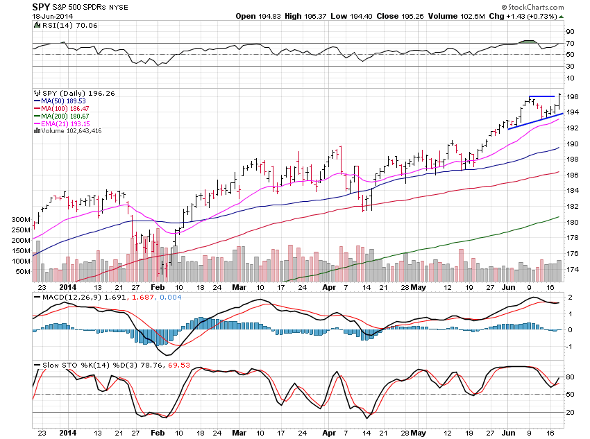
We saw some great moves and some superb closes in many leading stocks. The closing price is always the most important price to focus on. Let's move right into the SPDR S&P 500 ETF Trust (SPY) chart that has now cancelled out the small head and shoulders pattern and should now rip higher -- just how I like it. I am still into margin and only did one trade today, adding a new long position. SPY is now breaking out of the wedge pattern and off to the races.  Nice volume pushed it to the breakout point which is what I always like to see.

We remain in a very strong market environment and buying dips is a great strategy for now along with breakouts. No matter what the bears tell you, the action speaks for itself and that is what I listen to, not someone's opinion. We still are on track for a very busy and strong summer. Enjoy your evening. Warren Bevan This article represents the opinion of a contributor and not necessarily that of TheStreet or its editorial staff. >>Caveat Emptor, Investors: The Regulators Are Trying to Protect You

What’s the Best Whiskey Stock? STBFY, DEO & BF.B

Whiskey has become increasingly cool and popular thanks to the whole cocktail movement, something that's good for big whiskey stocks like Suntory Beverage & Food Limited (OTCMKTS: STBFY), Diageo plc (NYSE: DEO) and Brown-Forman Corporation (NYSE: BF.B) who also produce a wide variety of liquors and beverages. In fact, a recent episode of the Daily Ticker cited these stats from a USA Today article:

US whiskey exports exceeded $1 billion in 2013, up from $400 million just a decade ago. Whiskey sales rose 10.2% in 2013, according to the Washington-based Distilled Spirits Council. Reversing a two-decade long decline in its share of the US alcohol market, whiskey has gained 6 percentage points since 2000, to 34.7%.

However, there are some problems with whiskeys increased popularity – mainly the fact that it must be aged a certain number of years in barrel and lately we are drinking whiskey faster than the distillers can produce it. There's also a shortage of American oak to make barrels with that's expected to last for a year or two.

In addition, all whiskey is distilled from fermented grain mash but it's the location of production, the aging process and selected ingredients that are the key differences between whiskey, bourbon and scotch. Right now, "Tennessee whiskey" must be aged in a new, charred oak barrel but Diageo plc, the owner of the George Dickel Tennessee whiskey brand, is trying to get that law change to allow whiskey aged in used barrels to qualify for the label (see: Fight rages over definition of Tennessee whiskey)

With that in mind, here is a quick look at three important whiskey stocks or whiskey players:

Suntory Beverage & Food Limited. A soft drinks company with an integrated platform in four key regions (Japan, Europe, Oceania and Asia), Japan based Suntory Beverage & Food acquired Beam Inc (NYSE: BEAM) for $16 billion (a 25% premium) earlier this year (the sixth-largest ever in the beverage industry) to form the world's third largest premium spirits company. Beam Suntory's brands or products include the flagship Jim Beam bourbon and Yamazaki Japanese whisky, as well as world renown premium brands including Maker's Mark and Knob Creek bourbons, Hakushu and Hibiki Japanese whiskies, Teacher's, Laphroaig, and Bowmore Scotch whiskies, Canadian Club whisky, Courvoisier cognac, Sauza tequila, Pinnacle vodka and Midori liqueur. Beam Suntory generates annual worldwide sales of approximately $4.6 billion (excluding excise taxes). The deal was made in part because of Japan's aging population means Japanese companies need to look overseas for growth while a strong Yen last year has helped to fuel acquisitions. It should be noted though that while Suntory Beverage & Food Limited's stock does trade on the OTC in the USA, volume over the past two months has ranged from a low of 9,740 shares to a high of 761,630 shares. On Tuesday, Suntory Beverage & Food Limited rose 1.42% to $19.33 (STBFY has a 52 week trading range of $15.25 to $19.43 a share) for a market cap of $11.78 billion plus the stock is 18.9% since the start of the year and up 13.7% since October 2013.


Diageo plc. One of the world's leading premium drinks business, London based and listed Diageo plc's brands include Johnnie Walker, Crown Royal, J&B, Windsor, Buchanan's and Bushmills whiskies, Smirnoff, Ciroc and Ketel One vodkas, Baileys, Captain Morgan, Tanqueray and Guinness. Trading in approximately 180 countries and with offices in 80 countries, Diageo plc also has manufacturing facilities across the globe including in Great Britain, Ireland, United States, Canada, Spain, Italy, Africa, Latin America, Australia, India and the Caribbean. Near the end of May, Diageo plc announced its intention to invest an estimated $115 million over three years to build a 1.8 million proof gallon (750,000 9-liter cases) distillery and six barrel storage warehouses in Shelby County, Kentucky. The announcement noted that over the last year, Diageo plc's momentum in North American Whiskey has accelerated with both flagship and new-to-world brands. On Tuesday, Diageo plc rose 0.22% to $128.44 (DEO has a 52 week trading range of $111.87 to $134.08 a share) for a market cap of $80.61B plus the stock is down 2.2% since the start of the year, up 9.1% over the past year and up 129.4% over the past five years.

Brown-Forman Corporation. Founded in 1870 by George Garvin Brown in Louisville, KY, whose original brand, Old Forester Kentucky Straight Bourbon Whisky, was America's first bottled bourbon, Brown-Forman Corporation is one of the largest American-owned spirits and wine companies and among the top 10 largest global spirits companies – selling its brands in more than 135 countries. Geo. Garvin Brown IV, a descendant of the founder, is also part of the 5th generation of Brown Family members involved with the company and serves as the Presiding Chairman of the Board. Back in early June, Brown-Forman Corporation reported a that fiscal 2014 sales of Jack Daniel's rose 8% thanks to the rising popularity of Jack Daniel's Tennessee Honey with the CEO commenting:

"We are pleased to report another fiscal year of excellent organic growth, particularly in light of the moderating growth rates of our global competitors. I believe that our leadership position in premium American whiskey, led by the one and only Jack Daniel's trademark, and a very balanced geographic contribution, underpin the company's differentiated performance. We remain optimistic about the organic growth prospects for Brown-Forman, and our investment posture and fiscal 2015 earnings outlook reflect that optimism."

On Tuesday, Brown-Forman Corporation rose 0.16% to $93.97 (BF.B has a 52 week trading range of $66.41 to $94.86 a share) for a market cap of $20.04 billion plus the stock is up 24.4% since the start of the year, up 34.4% over the past year and up 102.9% over the past five years.

Apple, Inc.: We are Working on New Materials, New Areas

"Later this year, we've got the best product pipeline that I've seen in my 25 years at Apple," Apple's (NASDAQ: AAPL  ) VP of Internet, software, and services said at the Code Conference last month.

"Wait," some may protest, "Twenty five years? That includes the iMac, iPod, iPhone, and iPad -- the products that define Apple's greatest years under the iconic Steve Jobs. How can Eddy Cue say that?"

For Apple to make such a bold statement, the company should be readying an entirely new product for a 2014 launch. Even more, the new product -- or products -- should be revolutionary. That's about the only way the company could live up to such a statement.

Such a task won't be easy. But Apple seems more willing than ever to bend the possibilities of tomorrow -- even if it requires entirely new materials and new areas.

On new materials
Enter Apple's senior vice president of design, Jonathan Ive, arguably the company's most important executive after CEO Tim Cook. In a full transcript of an interview with Ive (made available yesterday) used for an in-depth profile of Cook by The New York Times that was published last weekend, Ive said Apple is making big moves into new areas and new materials.

I've worked for the last 15 or 20 years on the most challenging, creative parts of what we do. I would love to talk about future stuff -- they're materials we haven't worked in before. I've been working on this stuff for a few years now. Tim is fundamentally involved in pushing into these new areas and into these materials.

One new material that Apple is rumored to be making a big bet on is sapphire crystal. In fact, one analyst says that his supply checks indicate Apple could be prepping to deliver as many as 200 million annual devices with sapphire displays -- a level that would exceed current annualized iPhone sales by about 40 million.

Further, as MacRumors' Juli Clover explains, Apple may also be experimenting with Liquidmetal alloys and grapheme (a new manufacturing material). 

On new areas
And contrary to the critics' suggestion that Apple's innovation is faltering, Apple executives seem to think otherwise. Specifically, Ive says Cook has "not neglected" Apple's key tenet to always innovate. But patience for innovation is difficult -- and it always has been, Ive notes. On that note, Ive says he doesn't think anything has changed, "And that includes the clamor for some exciting new thing," said The New York Times writers Matt Richtel and Brian X Chen.

What is the "exciting new thing" Richtel and Chen are referring to? Probably the rumored iWatch. The ever-active Apple rumor mill is expecting the company to launch the device this fall, possibly shortly following the iPhone launch.

Apple investors should rest easy. Apple hasn't given investors any reasons yet to suggest it has lost its spirit of innovation, and it sounds like we'll soon get to see whether Apple can successfully push the boundaries in both new areas and new materials once again. Sitting and waiting is probably the best action Apple investors can take today.

A rare investment opportunity?
Apple recently recruited a secret-development "dream team" to guarantee its newest smart device was kept hidden from the public for as long as possible. But the secret is out, and some early viewers are claiming its everyday impact could trump the iPod, iPhone, and the iPad. In fact, ABI Research predicts 485 million of this type of device will be sold per year. But one small company makes Apple's gadget possible. And its stock price has nearly unlimited room to run for early in-the-know investors. To be one of them, and see Apple's newest smart gizmo, just click here!

Monday, June 16, 2014

Market Hustle: U.S. Stocks Mixed on Yellen Assurances, China Data

NEW YORK (TheStreet) -- U.S. stocks were mixed Wednesday, taking a breather after dovish statements on monetary policy from Federal Reserve Chairwoman Janet Yellen and better-than-expected data from China fueled a rally earlier in the session.
The S&P 500 was gaining 0.06% to 1,820.86 while the Dow Jones Industrial Average was off 0.10% to 15,979.53. The Nasdaq was 0.28% higher at 4,202.91. U.S. stock indices closed higher for the fourth consecutive session Tuesday as Yellen underscored in her testimony before the House Financial Services Committee that the central bank will continue to scale back its economic stimulus program at a guarded pace. She reminded investors that the window for raising the short-term fed funds rate remains firmly shuttered. Also fueling positive sentiment was the House's vote to raise the government debt ceiling until March 2015. International markets advanced after Yellen's appearance. The FTSE 100 in the U.K. on Wednesday was up 0.17%, the DAX in Germany was up 1.09%, the Hong Kong Hang Seng rose 1.47%, and the Nikkei 225 in Japan increased 0.56%. Caterpillar (CAT) was the top gainer in the Dow, up 1.6%, while Trip Advisor (TRIP) led gains in the S&P 500, adding 6.9% after it posted Tuesday a 26% rise in quarterly revenue, helped by a jump in display-based advertising. Bank of England officials now forecast that the U.K. economy will grow by 3.4% this year, faster than the 2.8% forecast in November. The BOE also said it expects upcoming data to show the unemployment rate in the U.K. fell to 7% in January. China's exports unexpectedly increased 10.6% in January, assuaging some concerns about the health of emerging market economies. St. Louis Federal Reserve Bank President James Bullard said the central bank would probably have to return to more "traditional" policy-making and "make more qualitative judgments" on when to tighten policy. Bullard was speaking at a panel in New York on Wednesday. The U.S. Treasury budget is due at 2 p.m. EST with a deficit of $30.8 billion expected for January.  Fourteen companies in the S&P 500 are expected to report earnings on Wednesday. Cisco (CSCO) is expected by analysts to report fiscal second-quarter earnings of 46 cents a share on revenue of $11.03 billion. Zillow (Z), the real estate Web site, is forecast to report fourth-quarter earnings of 7 cents a share. Whole Foods Market (WFM) is expected by Wall Street to report fiscal first-quarter earnings of 44 cents a share on revenue of $4.29 billion.  -- Written by Jane Searle in New York

Stock quotes in this article: DJI, ^GSPC, ^IXIC, CSCO, WFM, Z, CAT, TRIP 

Iraqis turn to Whisper app during conflict

Iraqis turn to Whisper app amidst conflict   Iraqis turn to Whisper app amidst conflict NEW YORK (CNNMoney) "U.S. Embassy in Baghdad is evacuating..!!!!"

That message appeared Saturday at 8 a.m. ET on a secret-sharing application called Whisper. The media reported about the embassy's partial staff relocation hours later.

During the intensifying conflict in Iraq, Whisper is becoming an outlet for Iraqis to share information and post their thoughts anonymously in short tidbits.

Over the weekend, Facebook (FB, Tech30) and Twitter (TWTR, Tech30) said they began investigating reports of service disruptions. Meanwhile, Neetzan Zimmerman, Whisper's editor in chief, told CNNMoney that Whisper usage in Iraq more than doubled between June 12 and June 15. The company declined to provide more specific usage metrics.

"All social media were stopped in Iraq my only escape is whisper," one Whsiper user posted. "Waiting our miserable destiny while ISIS progressing towards Baghdad!!!!!" another said.

According to Zimmerman, Whisper doesn't collect information that would identify users but it can use geolocation to ascertain a user's location within a 1 mile radius.. Zimmerman says Iraqis are posting everything from frustration with the government to every day issues about relationships and life in Iraq.

"On one hand, they're talking about concerns of what can happen," he told CNNMoney. "On the other hand, they're living life and communicating what's normal."

Whisper CEO shares users' darkest secrets   Whisper CEO shares users' darkest secrets

In one case, a user posted about his sexual identity.

"Gay and single in iraq makes you feel.....empty," the user wrote. "I need..a boyfriend to cuddle with before I get billed [sic] in a bomb ;["

Other users are expressing fear. "We r fine in Baghdad but we r ready for the worse [sic]," one wrote.

Applications like Whisper and Secret have recently become popular, though their secretive nature makes it impossible to verify the authenticity of the posts. Yet Zimmerman says he hopes the service will give users a safe platform to share their! thoughts.

"Ultimately ... you can use Whisper to vent or make statements that you would be concerned to make in an identity-based environment," he said.

Top Dow Dividend Stocks To Buy Right Now

If there's one lesson the rise of smartphones and tablets taught the world, it would be that everyday users don't need cutting-edge performance. Instead, sleek form factors and long-lasting batteries have been higher-priority selling points for everyday consumers. As a result, Intel's (NASDAQ: INTC  ) power-hungry processors haven't found their way into many mobile computing devices, and Intel stock investors haven't been able to benefit from the mobile computing revolution.

To that end, the company has been working relentlessly to shrink transistors so that it can close the power gap between itself and arch-nemesis ARM Holdings. Between Intel Haswell and Bay Trail, Intel stock investors are hoping that the company will not only make inroads in tablet computing, but also get consumers excited again about PCs.

The problem with Haswell isn't performance or power consumption, which improves battery life by 50% -- it's the price of entry for cutting-edge technology. At least in the beginning, I'm not anticipating Haswell processors will come cheap to consumers. According to AnandTech, Apple's recently released MacBook Air's Haswell processor costs $342 for the low-end or $454 for the upgraded version. That's a far cry from a $200 to $300 tablet, not to mention the everyday user doesn't necessarily need cutting-edge technology to surf the web and compose the occasional email.

Top Dow Dividend Stocks To Buy Right Now: Selectica Inc.(SLTC)

Selectica, Inc. provides contract management and sales configuration software solutions that allow enterprises to manage sell-side business processes. It offers Selectica contract lifecycle management (CLM) solution, a contract authoring, analysis, repository, and process automation product that is offered on-premise or hosted basis enables customers to create, manage, and analyze contracts in a single repository. The company also offers Selectica sales configuration (SCS) solution, which consolidates configuration, pricing, and quoting functions into a single application platform. It provides SCS solutions to manufacturers, service providers, and financial services companies to streamline the opportunity-to-order process. In addition, the company provides professional implementation and customization services; on-demand hosting services for CLM solutions; and complex product configuration modeling services for SCS solutions. It sells its CLM products primarily through its direct sales force and strategic and OEM partners, as well as SCS products primarily through partnership relationships in the United States, Canada, India, New Zealand, Switzerland, and the United Kingdom. The company was founded in 1996 and is headquartered in San Jose, California.

Advisors' Opinion:
  • [By The GeoTeam]

    Our recent 2013 articles on SaaS companies Selectica (SLTC), E2open (EOPN), Responsys (MKTG), Vocus (VOCS), and ExactTarget (ET) highlighted such opportunities. The average return since the inception of our coverage currently stands at around 34% (55% at their highs).

Top Dow Dividend Stocks To Buy Right Now: Morgan Stanley Technology Etf (MTK)

SPDR Morgan Stanley Technology (ETF) (the Fund), formerly Morgan Stanley Technology ETF, seeks to replicate as closely as possible the performance of the Morgan Stanley Technology Index (the Index). The Fund utilizes a passive or indexing approach and attempts to approximate the investment performance of its benchmark Index, by investing in a portfolio of stocks intended to replicate the index.

The Fund�� industry breakdown includes communications equipment, software, computers and peripherals, semiconductors and semiconductor equipment, information technology (IT) services, Internet software and services, Internet and catalog retail, and electronic equipment and instruments. The Fund�� portfolio includes AMAZON.COM, INC, FIRST DATA CORP., JUNIPER NETWORKS, INC., APPLE, INC. and EMC CORP.

Advisors' Opinion:
  • [By Selena Maranjian]

    Exchange-traded funds offer a convenient way to invest in sectors or niches that interest you. If you'd like to add some tech-heavy stocks to your portfolio, but don't have the time or expertise to hand-pick a few, the SPDR Morgan Stanley Technology ETF (NYSEMKT: MTK  ) could save you a lot of trouble. Instead of trying to figure out which companies will perform best, you can use this technology ETF to invest in lots of them simultaneously.

    The basics
    ETFs often sport lower expense ratios than their mutual fund cousins. The technology ETF's expense ratio -- its annual fee -- is a relatively low 0.50%. The fund is fairly small, too, so if you're thinking of buying, beware of possibly large spreads between its bid and ask prices. Consider using a limit order if you want to buy in.

Top 10 Restaurant Companies To Own For 2015: Kazakhmys PLC (KAZ)

Kazakhmys PLC, along with its subsidiaries, is natural resource company focused on the production of copper. It is engaged in the production of copper and other metals as by-products, including zinc, silver and gold, and power generation. The Company�� segments are Kazakhmys Mining, which is engaged in the exploration, evaluation, development, mining and processing of mineral resources and sale of the metal products; MKM, which operates in Germany, where it manufactures copper and copper alloy semi-finished products; Kazakhmys Power, which operates in Kazakhstan, and consists of its captive power stations, the Ekibastuz GRES-1 coal-fired power station joint venture, and Kazakhmys Petroleum business, which holds a license to conduct oil and gas exploration and development activity in the East Akzhar Exploration Block in western Kazakhstan. In May 2011, the Company completed the disposal of the small Maikuben West coal mine. Advisors' Opinion:
  • [By Alexis Xydias]

    Kazakh miners ENRC (ENRC) and Kazakhmys Plc (KAZ) slid 3.7 percent to 204 pence, and 2.4 percent to 258.7 pence, respectively, as the FTSE 350 Mining Index fell for the third time this week. African Barrick Gold Plc tumbled 7.7 percent to 96 pence, a record low.

Top Dow Dividend Stocks To Buy Right Now: ProtoSource Corp (PSCO)

ProtoSource Corporation, doing business as Software Solutions Company, incorporated on July 1, 1988, primarily focuses on the delivery of ePublishing solutions and related services, to newspapers, retailers, and magazines, utilizing internally-developed, applications bridging the divide between traditional print revenue and the opportunities online via a coordinated sales and marketing strategy in the United States and Europe. The Company has two suites of services and solutions offered by its two principle operating units: P2i Newspapers and BX-Solutions.

P2i Newspapers offers products and services tailored specifically to support the online publishing of editorial content, advertising, discounts, deals and offers. Every day of the week, 52 weeks a year, P2i receives electronic files from customers at its facility in Cyberjaya, just south of Kuala Lumpur, Malaysia. Incoming data files are processed overnight for delivery the following morning. Data is delivered not only to P2i's Web servers for seamless integration into its clients' existing, hosted Websites, but also distributed back to clients and their business partners in a range of formats.

The Company's second facility in Fresno, California, operated by, and branded as, BX-Solutions, is a wholly owned subsidiary of ProtoSource Acquisition II, Inc., which provides around-the-clock english and spanish technical support via incoming telephone calls from the customers of technology companies. These comprise small and mid-size Internet service providers (ISP) and telecommunication companies in the United States. This facility also houses and manages servers for its own customers.

The Company competes with Print2Web, Travidia, ShopLocal, Mactive and Olive.

Advisors' Opinion:
  • [By Vanina Egea]

    As for global expansion, Wal-Mart is focusing on emerging economies to drive further growth. Along these lines, its main target is China where the firm plans to open over 100 outlets between 2014 and 2016. According to the Institute of Grocery Distribution, retail market of China is expected to grow 11% by 2015, while the U.S retail business will only enlarge at a rate of 4.2% in the same period. However a good opportunity for its business, after 15 years in the country WMT is still struggling to achieve the strong position that it has in other markets. Tough competition from Sun Art Retail Group Ltd. (SURRF), the largest hypermarket operator, and the joint venture between Tesco TLC (PSCO) (the largest U.K. retailer) and China Resources Enterprise Ltd. (0291.HK), make WMT麓s growth arduous. The company has 3% of China麓s market share while Sun Art boasts a large 14%. Nevertheless, the company consistently keeps on the growth path by means of a continuous improvement in the perception of Chinese customers麓 preferences and the opening of new stores to reach the scale needed to compete. Low costs of labor in this country benefit the company to a great extent.

Top Dow Dividend Stocks To Buy Right Now: Visteon Corporation(VC)

Visteon Corporation supplies automotive systems, modules, and components to automotive original equipment manufacturers worldwide. The company offers a range of electronics products, including audio/infotainment systems and components, such as base radio/CD head units, infotainment head units, audiophile systems and amplifiers, rear seat family entertainment systems, digital and satellite radios, HD and DAB broadcast tuners, MACH voice link technology, and connectivity solutions for portable devices; driver information systems comprising instrument clusters and displays to assist driving; and powertrain and feature control modules, including controllers for fuel pumps, transfer cases, tuning valves, and security and voltage regulation systems. It also provides electronic climate controls, such as single zone manual electronic and automatic multiple zone modules, as well as integrated audio and climate control assemblies; and lighting products consisting of headlamps, stop lamps, and fog lamps. In addition, the company offers integrated heating, ventilation, and air conditioning systems, which include evaporators, condensers, heater cores, climate controls, compressors, air handling cases, and fluid transport systems; and components and modules that provide cooling and thermal management for the vehicle?s engine and transmission, as well as for batteries and power electronics on hybrid and electric vehicles. Further, it provides interior products, including cockpit modules, which incorporate structural, electronic, climate control, mechanical, and safety components; door panels/modules and interior trim products; and console modules, which deliver storage options. The company was founded in 2000 and is headquartered in Van Buren Township, Michigan.

Advisors' Opinion:
  • [By Seth Jayson]

    Visteon (NYSE: VC  ) reported earnings on May 9. Here are the numbers you need to know.

    The 10-second takeaway
    For the quarter ended March 31 (Q1), Visteon beat expectations on revenues and crushed expectations on earnings per share.

  • [By David Sterman]

    Auto parts maker Visteon (NYSE: VC) clearly embodies the new thinking about share buybacks. The company announced plans last month to sell its $1.5 billion stake in a joint venture with a Chinese partner. Visteon could have looked to pay down debt or make an acquisition, or simply keep the ($1.2 billion after-tax) proceeds. Instead, almost all of the money will go toward a share buyback that might reduce shares outstanding by 25%.